
This week, a senior national security delegation from the Mecca Defense Alliance – the mutual-defense pact signed in September between Pakistan, Saudi Arabia and Türkiye – met in Tehran.
Leading the delegations were:
Asim Munir, Commander of Pakistan's Army
Ibrahim Kalin, Head of Türkiye’s Intelligence Agency
Khalid bin Salman, Saudi Arabia's Defense Minister
They met with Mohsen Rezaee, Secretary of Iran's Supreme National Security Council.
In our view, this meeting has a number of important implications.
First, it shows how Iran’s relative power in the region has increased since the United States and Israel launched their war in February. The symbolism of where the meeting took place and the seniority of the figures in attendance are both noteworthy. The Islamic Republic is already seizing on the PR dividends by labelling the meeting as the Tehran Summit. The attendees must have known ahead of the meeting that there was a very real possibility Tehran would use the occasion to demonstrate to its support base that the decisions it has taken since February, and the sacrifices made so far, have not only been worth it but are now beginning to bear fruit. The attendees clearly thought this was a price worth paying by travelling to Tehran.
Second, the Tehran meeting is an early indication that rather than the Mecca Defense Alliance (MDA) being aimed purely at countering Iran, it may in fact emerge as a framework for including Iran in a new, emerging regional security architecture. It is noteworthy that the meeting was between the countries’ leading security figures, not the heads of state or government. While we need more evidence to be sure, it is increasingly clear that a regional-security architecture could well have the backing of those in Washington trying to seek an off-ramp. Last week, the U.S. ambassador to Turkey and U.S. Special Envoy for Syria, Tom Barrack, told the Global Security Forum in Doha that:
America as the guarantor to the world, for the last 80 years, it is no longer there… Everybody's got to be on their own regional alliances…which is what’s happening.
The current MDA members have likely concluded that any post-American regional order, at least one which is sustainable, must now include Iran. Underscoring how this was likely an area of discussion in Tehran, Rezaee told Iranian state news:
All three of them believed that if our four countries come together, many of the region’s problems can be solved. The result is that we had an agreement; the method was that regional security where we are, where we live, this must be endogenous, meaning it should be achieved by the countries themselves. I hope this trip will be the beginning of a real transformation [in the region].
This brings us to our third point. “Many of the region’s problems can be solved” is clearly a reference, in part, to the Houthis. Since July 21, the Houthis have placed Saudi Arabia under a maritime blockade. In September, they strengthened their control over the Bab el Mendeb. And in October they began striking Saudi airports and energy infrastructure. The Houthi strikes appear to be hitting Saudi Arabia where it hurts; in the pocket. During the early stages of the war, there was little-to-no market reaction.
But in the last few weeks there has been a change.
Saudi Arabia 5-year credit default swaps (CDS’) have broken above the 200-day MA for the first time since April. In WILTW October 15, we warned that the USD-denominated iShares Saudi Arabia ETF (KSA) was just beginning to break support from a 3-year upward trendline. Since that article, the price action has now confirmed that a fairly unambiguous breakdown is currently underway. We could now be seeing a multi-year “rounding top.” The 40- and 120-week MAs have registered a “death cross,” the decline in MAs appears to be accelerating and the price-action is all taking place below the breakdown area and the falling MAs.
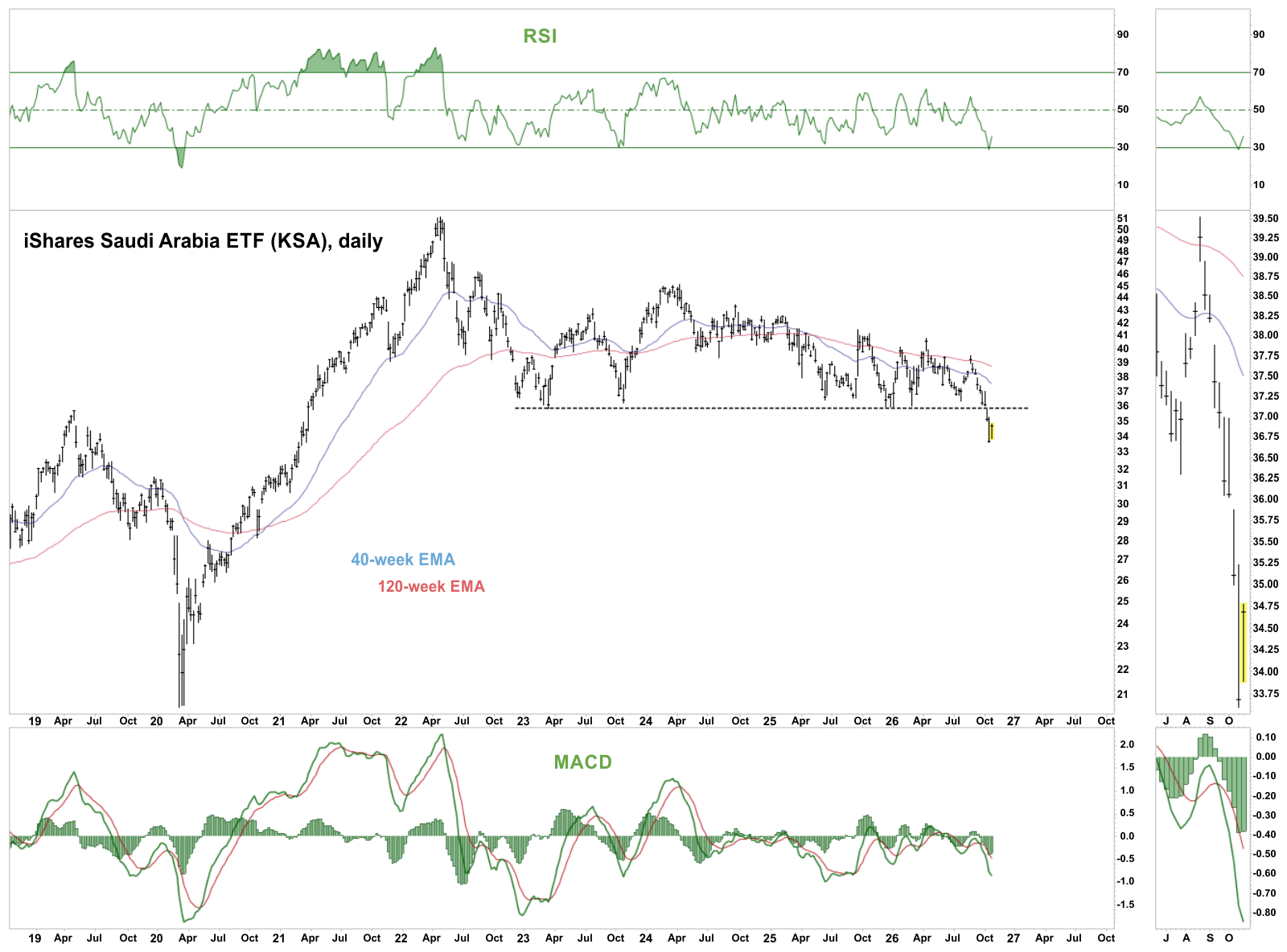 Source: StockCharts
This bearish price action is in addition to Saudi drawing down on its foreign currency deposits held abroad by 18% between March and August (the latest available data). It is highly likely these deposits have been further drawn down in the last two months. These bearish developments may have been one reason behind the meeting’s timing and why the Saudi Defense Minister was willing to travel to Tehran.
MBS has built his legitimacy around making the Kingdom a hub for global investment and capital. If the Saudis have calculated that Tehran can withstand American economic and military pressure longer than the Kingdom can withstand pressure from the Houthis, particularly if military support from Trump is not forthcoming, then the prospect of an emerging regional architecture that includes Iran becomes more likely.
Fourth, if we are seeing early signs of an emerging regional architecture that includes Iran while at the same time the U.S. wants to pull back its security umbrella, this would pose a more dangerous security environment for Israel, particularly at a time when it finds itself more isolated on the international stage following the Gaza war. At the time of writing, exit polls from the Israeli election show that no party is winning a clear majority and no party has yet a clear path to form a coalition and the next government. This means that Netanyahu could remain care-taker Prime Minister until a new coalition is formed. This may take weeks, it may take months. In 2018, it took 17 months.
The key point is that Netanyahu – the ultimate political survivor with a long list of comebacks – could use escalation with Iran as a way to form a national unity government and to hold onto power, at least for the time being, despite losing his majority. The domestic political landscape in Israel may be influenced as much by events in Iran over the coming days and weeks as the election result itself.